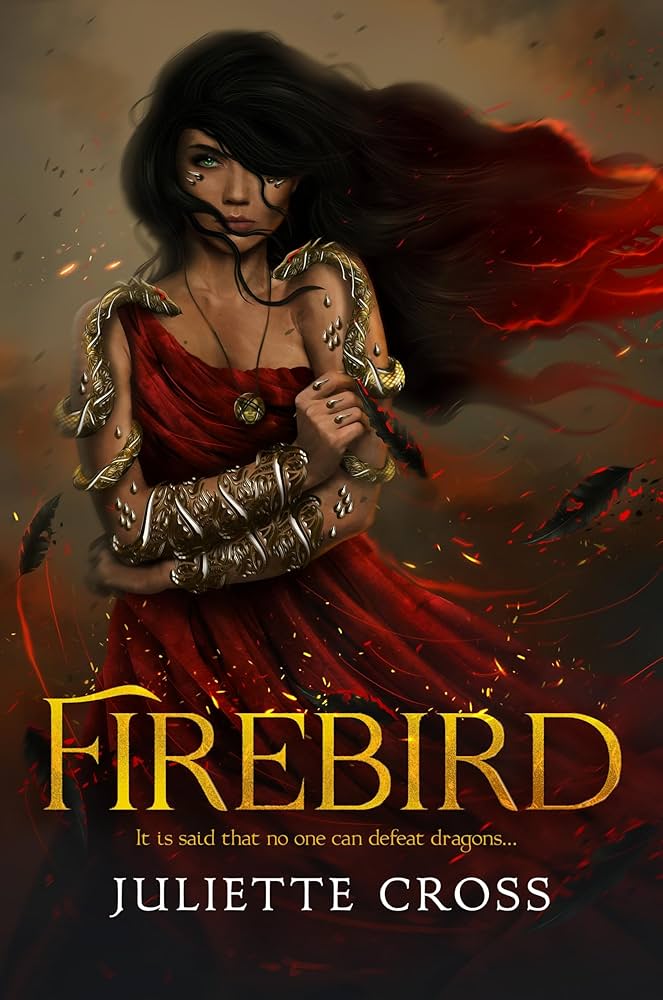
Firebird by Juliette Cross is the first book in the new Fire That Binds series, first published on April 8, 2025. Cross, a self-proclaimed mood writer, dabbles in numerous genres like contemporary romance, fantasy, and paranormal romance.
In Firebird, she takes us on a reimagined journey through Ancient Rome—one ruled by powerful dragon shifters. This is a dark fantasy romance set in a world of conquest, corruption, and a captor-captive forbidden romance between a fierce Dacian dancer and a decorated Roman general.
Firebird content warning
If you’re sensitive to graphic violence and explicit assault scenes, probably sit this one out. But if you’re looking for a book that feels like Spartacus meets the Targaryen in-fighting of House of the Dragon, definitely add this to your TBR. I could not put it down.

Recently, there have been claims that this book romanticizes the master-slave dynamic, as well as the relationship between colonizer and conquered, and after finishing the book, I found those claims to be inaccurate. I go into greater detail in the book review section of this post.
Since we’re not getting the sequel Bloodsinger until winter 2026, this guide should help refresh your memory whenever the next book releases. And per Juliette Cross herself, she’s already seen the cover art for Bloodsinger and teases that it is equally stunning. The Fire That Binds will be a trilogy.
In this guide, you’ll find:
- Firebird book characters
- dragon types in Firebird
- locations in Firebird
- Firebird book summary
- ending explained
- unresolved questions
- my favorite quotes
- book review/final thoughts
Important: this guide contains MAJOR SPOILERS. If you haven’t read it, consider yourself warned.
Characters in Firebird by Juliette Cross
Who is Malina Bihari?
Malina is a young Dacian woman from the Carpathian Mountains. She—along with her three sisters—are gifted dancers, but Malina is also what’s called an empath. When we meet her, she’s the only one of her sisters with this power, and she uses it to create an invisible tether to whomever she chooses and can read their emotions and intentions. She can also compel them to feel whatever emotions she wants.
Malina is captured in Gaul after previously helping the Celts beat back the Romans on more than one occasion. She is made the body slave to General Julianus who calls her Firebird.
Who is Julianus Ignis Dakkia?
Julian is a high-ranking Roman Legatus (General) of the Ignis dragon line & nephew to Caesar. His parents were murdered years before, and his uncle Igniculus became his sole family. Julian is a powerful red dragon shifter who met Malina 4 years ago when he was a centurion.
After Gaul, he becomes Malina’s master. Later, her mate. He is known in Rome as the Coldhearted Conqueror. He has been working in secret for years to overthrow his corrupt uncle and believes that Rome is no longer a place of virtue and ethics.
Other characters
| Name | Description |
|---|---|
| Lela Bihari | Malina’s older sister, described as sweet and gentle. Betrothed and later married to Jardani, she is presumed dead following the attack during her wedding night. |
| Kizzy & Kostanya Bihari | Malina’s younger twin sisters. Presumed dead following the attack during Lela and Jardani’s wedding night. |
| Jardani | Lela’s betrothed/husband. Attacked during the raid on their village. Killed on his wedding night to Lela. |
| Hanzi | A member of Malina’s caravan & skilled with swords and juggling. Had feelings for Malina, but is presumed dead after the village attack. |
| Bunica | Malina’s grandmother, who possessed the gift of sight. Foretold Malina’s destiny. Presumed dead. |
| Trajan Tiberius | Julian’s most trusted friend, a Sapphirus (blue) dragon. Part of the conspiracy against the Emperor. Grandson of Senator Gaius. Tall, bronzed skin, and light blue eyes. |
| Emperor Igniculus | Cruel Emperor of Rome & Julian’s uncle. Of the Ignis line, known for his brutality, public executions, and decadent feasts-turned-orgies. Revealed to have murdered Julian’s parents. |
| Ruskus | Julian’s Thracian head servant who manages the household. He has a limp. Loyal to Julian. |
| Kara | Julian’s cook and laundress. Previously his mother’s slave. Stern but caring towards the household members. |
| Stefanos | A young boy slave in Julian’s household. Revealed to be a dragon bastard hidden by Julian—lineage unknown. Close to Kara and Ivo. |
| Ivo | A large, mute Macedonian slave who tends Julian’s stables. Saved by Julian from his previous cruel master, Valerius. Protective of Stefanos and Malina. |
| Enid | An older Celtic woman who took Malina in after her village was destroyed. Captured by Julian’s army and later rescued from the slave market by Julian at Malina’s request. Dies from injuries sustained during capture. |
| Silvanus | A cruel Roman soldier of the Griseo (gray) line. Attempts to assault Malina after the Celtic battle but is killed by Julian’s dragon form. |
| Ciprian Media Nocte Seneca | An ambitious and cruel Roman prefect (later Legatus) of the Media Nocte (black) line. A rival to Julian, chosen for the Rite of Skulls. Becomes Malina’s master briefly after Julian is forced to give her up. Julian rips his head off. |
| Legatus Bastius | Julian’s predecessor in Gaul, defeated 3x by the Celts (with Malina’s help). Executed by Emperor Igniculus for his failures. |
| Aodhan | A Celtic warrior and friend to Malina in the adopted clan. Romantic interest until he was killed by a Roman soldier. |
| Senator Gaius Tiberius | Trajan’s grandfather, head of the Sapphirus line, and an ally in the plot against the emperor. |
| Senator Otho | A senator who opposes the Emperor and is publicly humiliated at a feast when Caesar takes his wife in front of everyone. |
| Sabina Amethystus Candida | Otho’s young wife, used and humiliated by the Emperor at a feast. |
| Fausta Media Nocte | A beautiful noble widow & Ciprian’s cousin, present at Julian’s feast. Caesar wanted Julian to marry Fausta. |
| Consul Valerius | A cruel consul loyal to the Emperor. Ivo’s former master. |
| Camilla | Julian’s aunt, sister to the Emperor and Julian’s father. A Vicus (white) dragon priestess driven mad by the Emperor and kept chained in dragon form in a pit (her brother the Emperor wanted to marry and bed her). |
| Rhea | A talkative young slave girl in Ciprian’s household who befriends Malina. Likely Celtic. Uses silphium to prevent conception. Escapes with Doro after Ciprian’s estate is destroyed. |
| Doro | A large slave in Ciprian’s household who is protective of Rhea. Escapes with Rhea. |
| Euphemia | An apothecary in the Aventine district who provides Malina with dragon skin for a ritual. Reads auras. Gave rites to the gladiator Livius. |
| Livius | A famed Griseo gladiator who refused to kill a priestess and was executed by the Emperor. His skin was used by Euphemia. |
| Barbarian horde leader | A giant, Germanic-accented warrior who fights Julian in Moesia—Julian’s only defeat. Wears black war paint and wields a poisoned blade. Revealed to be an incredibly powerful dragon shifter. Leads a mysterious horde. Could this be a shifter of the lost legendary dragon line?? |
Types of dragons in Firebird
| Dragon house | Description |
|---|---|
| Ignis | Fire-red line. Descended from Romulus, who founded Rome. This line holds more dominance and power. Julian belongs to this house. |
| Media Nocte | Midnight-black line. Descended from Remus, Romulus’s brother. Ciprian belongs to this house. |
| Sapphirus | Sapphire-blue line. The first line born after Ignis and Media Nocte. Born from a coupling between Neptune and Romulus’s eldest daughter. Trajan belongs to this house. |
| Amethystus | Amethyst-purple line. Descended from a child of Pluto and Proserpina. Sabina belongs to this house. |
| Chrysocolla | Malachite-green line. Blessed into existence by Diana, whose arrow struck a Sapphirus dragon mating with her nymph Egeria, changing its color. |
| Griseo | Gray line. The lowest caste of dragons with no known ancestry. Often used in gladiator arenas. Silvanus and Menteo belong to this house. |
| Vicus | White dragon. An anomaly of only female dragons born of any house. Chosen by the gods to serve as honored priestesses. Medusa was born a white dragon. Julian’s Aunt Camilla (Caesar’s sister) is a Vicus. |
| Chrysos | Gold dragon. Legendary, extinct line with extraordinary fire power. Believed to be touched by Jupiter himself, though origin is unknown. Aurelia (from the story Rhea tells) was a gold dragon. |
Firebird locations
| Location | Description |
|---|---|
| Dacia | Malina’s homeland, modern-day Romania. Setting of the prologue. |
| Carpathian Mountains | Mountain range near Malina’s home village in Dacia. |
| Gaul (Eastern border) | Region where Julian leads a campaign against the Celts and recaptures Malina. |
| Rome | The capital city of the dragon-ruled empire. Seat of Emperor Igniculus. Features opulent homes, the Forum, the Colosseum, and temples. |
| Julian’s Villa (Palatine Hill) | Julian’s luxurious home on Palatine Hill overlooking Rome. Features large rooms, an atrium, mosaics, and multiple terraces. |
| The Forum | The central public space in Rome, containing the Curia (senate house), markets (including the slave market), temples, and the Walls of Victory and Traitors. |
| Slave Market | Located within the Forum, where captured people are sold. Run by Menteo. |
| Wall of Victory / Wall of Traitors | Walls flanking the Curia in the Forum where the heads of defeated enemies and executed traitors are displayed on pikes. |
| Colosseum | Large arena in Rome, mentioned as the location for Julian and Ciprian’s duel. |
| Emperor’s Palace | Igniculus’s opulent and decadent residence, site of infamous feasts and cruelties. Includes a pit where he keeps his sister Camilla chained. |
| Temple of Minerva | Temple in Rome mentioned in the Myth of Medusa. Minerva is the goddess of war and wisdom. Malina visits this temple. |
| Temple of Vesta | Temple in Rome housing Vestal Virgins. Julian’s aunt Camilla served here before being removed by the Emperor. |
| Temple of the Dead | Temple in Rome dedicated to Pluto and Proserpina. Malina prays here for her family and Enid. |
| Moesia | Roman province near Dacia and Thrace where Julian is sent on campaign against mysterious barbarians. |
| Singidium | Roman town in Moesia burned by the mysterious barbarians. Site of Julian’s encampment. |
| Ciprian’s House | Located on Palatine Hill, smaller and less opulent than Julian’s. Malina is held here briefly. Destroyed by Julian’s dragon form. |
| Aventine | Plebeian neighborhood in Rome where Rhea prefers to shop. Site of Euphemia’s apothecary shop. |
| Euphemia’s Apothecary Shop | Shop in the Aventine district where Malina obtains dragon skin for a ritual. |
| Vulsinii | Location of Senator Gaius’s home, where the conspirators meet. |
| Pisae | Location of one of Trajan’s homes, where Julian and Malina stop briefly after fleeing Rome. Near the Tyrrhenian Sea. |
| Britannia | Island province where Trajan has a secret home. Julian and Malina’s destination. Location of the epilogue. |
What happens in Firebird by Juliette Cross (book summary)
Medusa & her sisters
Firebird by Juliette Cross begins with the ancient story of a girl named Medusa who was born a white dragon, a Vicus. Her dream was to serve the gods and when she was older, she was selected to serve as a priestess in the Temple of Minerva, the goddess of war and wisdom.
One day, the god Neptune spied her meditating on the shore and was overcome by lust. He followed her back to the temple and assaulted her on Minerva’s altar, leaving her spirit broken, her body bloodied. Her two sisters found her there and together they cried. Without her maidenhood, Medusa would be cast out from the temple—the reality of which she found unbearable.
A snake, a siren, a kiss of death
Minerva heard the sisters’ cries and pleas, appearing with her wings and horns. She granted each of the three sisters sorcery over men. Medusa was gifted the power of a snake—to latch onto any man and fill them with any emotions she chooses, controlling them.
One sister was gifted the power of a siren—one taste of any man’s blood and she can compel them to do anything she commands, even take their own life.
The second sister was gifted the power of Pluto’s ferryman in the Underworld, Charon—with one kiss, she can breathe death into any man, punishing their soul. (There is a theory about Pluto’s moon, Charon, and how it was formed by colliding with Pluto itself, hence “Charon’s Kiss,” which I found fascinating. The theory states the collision could have lasted a few hours, merging Pluto and Charon into one celestial body—like a kiss—before spinning apart. The more you know!)
Minerva told the mortal sisters to wield their sorcery against evil men to punish and damn them. When Medusa asked when their work would be complete, the goddess basically says never, “When evil men no longer roam this world.”
The sisters eventually grow old and die, their souls resting with Pluto. But their powers remained on earth, passing from woman to woman through the centuries until Minerva’s request is finally fulfilled.
A bewitching dancer meets a handsome Roman centurion
Firebird’s main story opens in Dacia, 53 BCE (modern day Romania). Malina Bihari, a 17-year-old Dacian dancer from a traveling troupe, prepares for the final show before returning home. Her older sister Lela is soon to marry Jardani. Four Roman soldiers unexpectedly show up for the show, including a handsome centurion, which alarms Malina and her family. Using her empathic gift, Malina senses no aggression from the centurion and notices his striking golden eyes that mark him as a fearsome dragon shifter.
Despite the potential threat, Malina performs her most alluring dance, captivating the centurion. He gives her a gold coin for the performance and secretly follows her when she goes off to examine the coin alone. The coin is special to him, a gold aureus with Lady Fortuna on one side that his mother had given him to use as a wedding gift one day. He tells Malina the goddess Fortuna thinks she’ll need the coin for good fortune. Wary of the Roman dragon, she accepts the coin, wearing it as a treasured symbol of hope.
Four years later
Caesar, Emperor Igniculus, commanded his nephew to deal with the Celts in Gaul. We learn his nephew is none other than the dragon centurion Malina met four years ago. He’s now Legatus Julianus Ignis Dakkia, an esteemed and feared Roman general and his uncle’s heir. In the aftermath of his victory over the Celts, Julian’s men are capturing survivors to sell at the slave market when he hears a woman’s cries. He discovers his soldiers, led by a gray dragon shifter Silvanus, are about to assault a woman they call a witch. It’s Malina.
Julian is overcome by uncontrolled rage and his dragon form erupts violently, slaughtering Silvanus for disobeying orders and threatening his “treasure.” He then snatches Malina in his claws and flies off to his villa in Rome, leaving his soldiers to wrap up the battlefield. Malina is pretty much in shock and terrified after first losing her family and now her adopted Celtic clan. All she has is the aureus around her neck, which seems to have only brought bad fortune.
Dancer, witch, slave
Julian deposits Malina on his terrace, shifting back into human form naked and disappears inside, leaving her alone until his head servant, Ruskus, appears. Malina is led to a large, well-furnished room, especially for a slave, that has books on philosophy and plays, which she can read. She gets cleaned up and is summoned to Julian, her new dominus (master). He reveals that he remembers her from before and she shares what happened to her family. Julian presses her about the details of her “witchcraft”—she can influence emotions, which she used against the Romans three times before (before Julian got involved). Julian designates Malina as his personal body slave (dressing, bathing, meals, and chambers) to keep her close.
Dissent in Rome
Malina adjusts to life in Julian’s household, befriending the small staff: Ruskus, the cook Kara, the shy giant Ivo, and the young boy Stefanos. Like them, she’s forced to wear a slave collar bearing Julian’s family name—reason being the Dakkia name holds power in Rome and will supposedly protect her when out in the city (spoiler alert: it doesn’t). She gets Julian to take her to the Forum to find and purchase her Celtic friend Enid (Enid had taken Malina in when she lost her family), and a soldier gets handsy with Malina. Julian gets angry and violently protective, taking care of it.
They buy Enid but she’s not well at all. As Enid is looked after, Julian and Malina try to play nice and strike a deal. Each night over dinner, Julian will answer any questions about his life if Malina answers his questions about her magic. They grow closer, Malina learning Julian’s parents were murdered, and that he secretly harbors Stefanos, a dragon bastard whose existence defies Caesar’s law. In fact, Malina notices that the few slaves in his household seem to all have been saved from worse fates. She senses conflict in Julian’s relationship with his uncle and the inklings of dissent.
The bond with Julian intensifies after Enid dies from the injuries she sustained in Gaul. Julian helps Malina honor Enid’s body through cremation rather than getting carted off to a mass grave. He incinerates her body with his dragonfire.
Barbarians in Moesia
After Enid’s death, Caesar dispatches Julian to investigate a growing problem with marauders attacking Roman provinces in Moesia. Julian decides to take Malina with him. After weeks of trying to locate the barbarian horde, Julian tracks them to a dense forest. This is strange because the barbarians had previously evaded the Romans, seeming to toy with them, leaving no traces or evidence of their presence again and again.
Julian realizes too late the forest is a trap and the horde surrounds his army, setting it on fire. Turns out, the so-called barbarians are unknown dragon-shifters of possible Germanic origin. Note: Moesia is just south of Dacia, both regions adjacent to Germania. (This foreshadows one of the historical events that led to the fall of the Roman Empire, with a Germanic barbarian leader defeating the last Roman emperor, Romulus Augustulus.)
Julian suffers a bad gut wound by the barbarian leader who is incredibly fast and powerful. This is Julian’s first loss.
Rite of Skulls
Back in Rome, Julian reports on his loss to Caesar and sees that Ciprian has been climbing the ranks, continuing to sow conflict between he and Caesar. Ciprian exposes Julian’s weakness for Malina, and Caesar commands Julian to host the Rite of Skulls to celebrate Ciprian’s promotion.

Shocking no one, Ciprian forces Malina to participate, tasting her blood, and there’s nothing Julian can do about it lest he destroy all plans for a coup. When entertainment fails to show at the party, Malina decides to dance instead. She uses her magic to force Ciprian to sleep and makes the Emperor drowsy, ending the party early.
Julian and Malina have an afterparty of their own and FINALLY act on their complicated feelings. Julian acknowledges her as his fated mate, his “treasure,” and that to him she is free. And Malina learns more about Julian’s past—his human mother, and his internal conflict with his reputation as the Conqueror. Julian confesses his involvement in a plot to assassinate his uncle and overthrow the corrupt empire, trusting Malina with his life. Malina vows to help him.
Firebird ending explained
The calm is shattered when Caesar forces Julian to trade Malina for Ciprian’s favored stallion as forfeit following their duel in the Colosseum, which Julian had obviously won. Ciprian knows of Julian’s plans for treason and attempts to get information out of Malina. For a short time, she’s able to counter his efforts and finds trust in his slave, Rhea.
Minerva’s temple
Rhea accompanies Malina on an errand to get dragon skin and then visit Minerva’s temple. Malina makes a bargain, offering the aureus and her blood if Minerva will protect Julian and destroy all her enemies. If Minerva does that, she will give back her empath power. A storm rolls in and Julian had secretly followed Malina into the temple. They steal a desperate, steamy moment together.
Back at Ciprian’s, he’s wisened up to Malina’s tactics and can smell that she’s been with Julian. He drugs her wine, temporarily suppressing her power, to torture information out of her. Malina uses her bond with Julian to send a desperate call for help. Julian loses his shit and quickly arrives at Ciprian’s almost in full dragon form. Ciprian is petty and reveals Igniculus was the one to murder Julian’s parents, and Julian rips his head off. And then he burns down Ciprian’s house and a considerable portion of the Palatine.
How does Firebird end?
Traitors to Rome, Julian flies Malina far, far away to safety. (He made escape plans for his household, so luckily everyone else got out, too.) Four months later in Britannia, Julian and Malina are living peacefully with Stefanos, Ruskus, and Ivo, but recent news from Trajan reports that Rome is tightening its grip on who can enter and leave the city, making their plans to overthrow Caesar that much harder.
But at least Malina and Julian are happily ever after…for now.
Plot twist: Lela lives
It seems Lela has potentially suffered a far worse time the past few years than Malina. After losing her family and husband on her wedding night, she’s now a slave to the corrupt Consul Valerius (Ivo’s former master). We learn Lela has the bloodsinging ability originally gifted to one of Medusa’s sisters. If she tastes a man’s blood, she can mind control him into doing anything, even taking his own life.
When Valerius first assaulted her, she bit his neck and ingested his blood, commanding him to cut his own throat. But another slave was there to save him and Lela was subdued. Now, Valerius forces her to wear a golden bridle that suppresses her tongue and binds her mouth closed. It’s a pretty horrible situation for Lela.
But there’s hope. As we see in the final scene, Trajan is still behind enemy lines spying on Caesar and his ilk, determined to stop the corruption. He meets Lela at Valerius’s villa on Palatine Hill and they’re instantly drawn to each other much like Malina and Julian were. Hmmmm.
Only 1.5 years to go until Bloodsinger comes out! 😭
Unanswered questions
- Who are the dragons in the barbarian horde that Julian fought in Moesia? ARE THEY THE LEGENDARY GOLDEN DRAGONS THOUGHT EXTINCT?!
- If Julian, Trajan, Gaius, and their allies succeed in their plot to assassinate Emperor Igniculus, how will they reform Rome exactly? (Can Rome even be saved, or is it too corrupt and the entire thing needs to burn down?)
- How powerful is Malina’s empathic power? We saw her lead to Celt victory 3x before Julian was forced to step in. Will Minerva really grant her request and kill all her enemies? (Maybe the better question is: how big of a presence will the gods have in the plot?)
- Will Julian’s aunt Camilla ever be freed from the pit and her dragon form? I want to know what terrified her so badly to stay that way! Igniculus gives incestuous Targaryen brother.
- What happened to Lela after all this time? Are she and Trajan mates?? Her blood/mind control ability is badass.
- If Lela is alive, what about the twins? According to the Medusa legend we were given at the start of the book, Minerva blessed Medusa and two sisters with powers. Did one of the twins survive, or will the third power be split if they’re somehow both alive?
- What are the full implications of the mating bond between Julian (a half-human dragon) and Malina (a human with magic)? WHY IS IT IMPORTANT?
Firebird book quotes
You are wise as you are beautiful, little firebird.
His face was too hard, too sharp, too arresting. His maker had cut him with an unforgiving blade, molding him into a beast of unquestionable dominance and terrible beauty.
Dragons were a violently territorial and possessive species.
You are mine and you are his, and we’ll both die protecting you.
We might both burn for what’s to come.
A philosopher once said that while we cannot always control our circumstances, we can control how we react to them. It is better to take advantage of the smallest of gifts in these hard times. Take what you can, cherish what will give you peace and strength for the difficult roads that lie ahead.
No chains or pain will ever hold us here. If we ever hold the sword, it is us they will fear.
Do you know there were so many nights I lay alone in my tent in some foreign part of the world, feeling disconnected from everyone and everything in my life? When I felt the absolute loneliest, you would visit me.
Since that moment I saw you, flying across that stage, you have been burning inside me ever since. My entire soul is on fire for you, Malina. And always will be.
Book review: Firebird by Juliette Cross (The Fire That Binds #1)
I loved everything about Firebird by Juliette Cross—the writing, the setting, the world-building and lore, the fated romance. And I think the graphic violence and brutality of the story feels true to Ancient Rome. I was honestly baffled why it’s rated 3.6 on Goodreads. Me being me, I did some digging.
From what I can tell, one of the biggest criticisms seems to stem from readers who went into it with the wrong expectations, so potentially a marketing issue. The book is DARK. It’s violent. There are numerous graphic scenes depicted. When I said it’s like Spartacus meets House of the Dragon, that’s exactly what I mean. Gore, sex, body parts, assault, violence, killing. Sensitive audiences should steer clear.
Does Firebird romanticize colonizers or master-slave dynamics?
In short, no. By nature of who Malina and Julian are, their relationship is much more nuanced than reducing them to a master-slave/captor-captive dynamic. Cross purposefully sets up heavy themes, then later subverts them. Malina represents a conquered people and Julian represents Empire. Some readers can’t get past the initial setup and dismiss Firebird as a colonizer romance (or as romanticizing master-slave relationships), but let me explain why that thinking is reductive and doesn’t acknowledge the full picture.
This is important, so I will get this out of the way, but Igniculus’s empire in Firebird is never treated as a beacon of goodness and ethics. Cross makes it abundantly crystal that the Roman Empire here is a terrible place full of corrupt, power hungry men, violence, and greed. There is zero romanticizing of what Rome stands for in this story.
Romanticize: to deal with or describe in an idealized or unrealistic fashion; make (something) seem better or more appealing than it really is.
This does not describe what’s happening in Firebird, at all. Rome is very much depicted as the villain, as are the politicians and military leaders who enjoy its benefits or do nothing to change it. Malina herself spends the entirety of this book rightfully upset and hating the empire and everyone in it because of what it’s taken from her. She continuously struggles with the idea that Julian could be fighting to bring down the same system that destroyed his family and the lives of the slaves he harbors in his household.
Julian’s & Malina’s portrayals
Julian’s mother was a commoner, a fully human woman, and his father was a dragon-shifter and brother to Caesar. Caesar—Augustus’s own brother—murdered him, and then tried to groom Julian into being just as cruel and evil as he is. And rather than bend to Caesar’s corruption, Julian fought to overthrow him.
Malina is a full-human Dacian woman (so we’re told) whose family and home was destroyed by the Romans. When she’s bought and placed in Julian’s household, she detests him and everything he stands for. Even when she develops feelings for him, she struggles with these complicated feelings and the guilt and shame she feels—until she learns Julian’s truth and endgame. The dynamic between the two of them is treated with sensitivity and care. Cross isn’t romanticizing any of these difficult dynamics, she’s actually subverting what’s initially presented in the book and critiquing the world and its people at large.
My take
As a biracial woman with a white, retired military dad and a mom from the Philippines—a country that has a nearly 500-year history of being colonized, has been colonized by three different countries, and is still occupied by the United States—I am begging book influencers to think more critically before throwing out inaccurate accusations.
Rampant pageantry and shallow virtue signaling has gotten out of hand in bookish spaces over the last few years, often doing more harm than good. I challenge readers to think critically about a book’s themes and the author’s intent rather than parroting influencer hot takes, especially when those influencers didn’t bother to think past the surface-level conflicts initially presented in the book (let alone bother to finish it). Whew!
Who should read Firebird
If the premise of Firebird sounds intriguing to you and you enjoy stories with historical influence, rich world-building and lore, complex relationships, deep exploration of heavy themes, and a resilient, powerful FMC, I 100% recommend Firebird by Juliette Cross.
I’m so pumped for Bloodsinger in 2026 and can’t wait to see where she takes this story.
If you finished the book, I’d love to hear your thoughts and theories on what will happen next. Happy reading!

Leave a comment